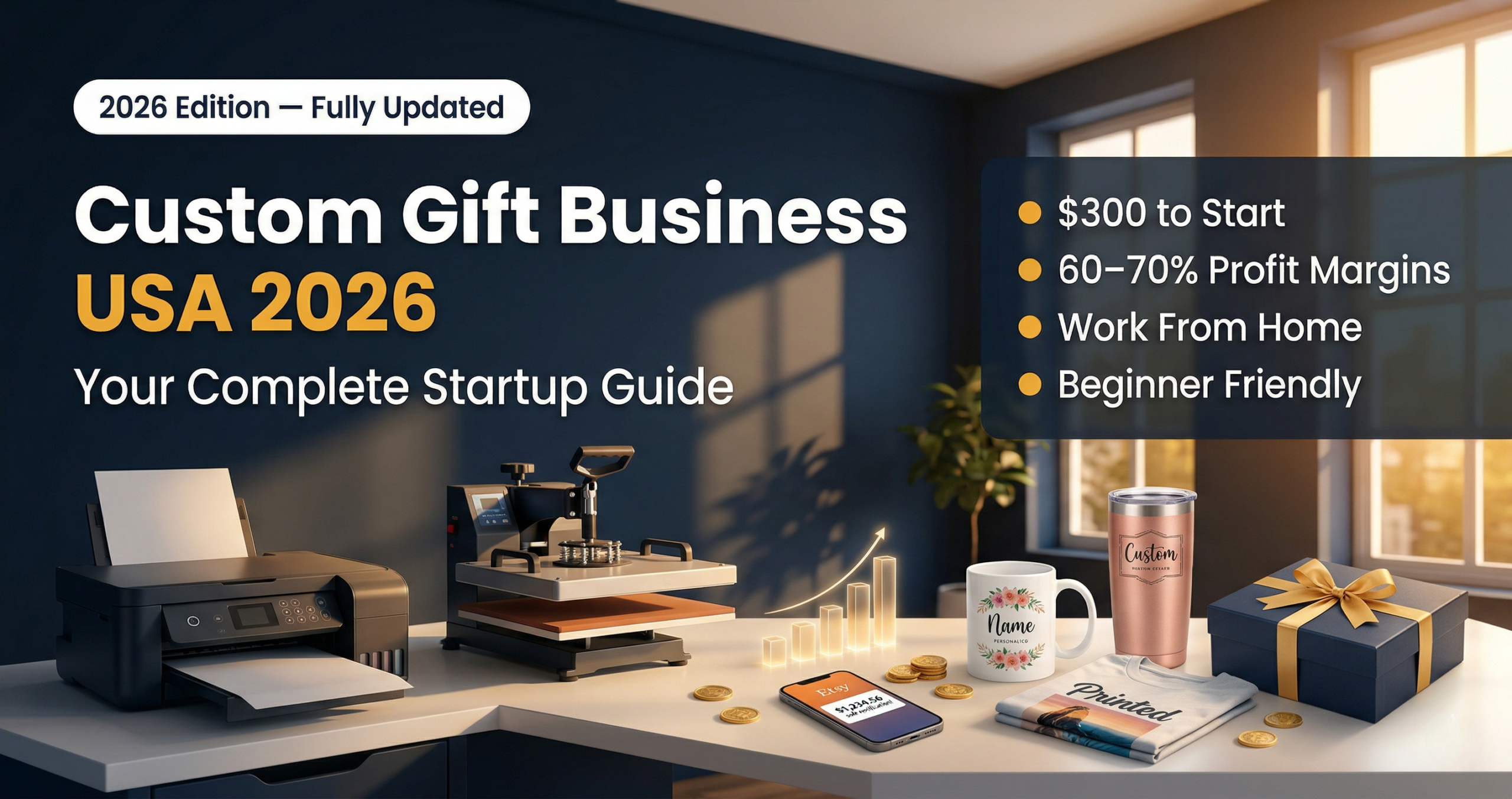
Introduction: Why the Custom Gift Business Is the Opportunity of 2026
If you have been searching for a home-based business idea with real income potential, low startup costs, and genuine consumer demand, the custom gift business in the USA deserves your full attention in 2026.
The personalized gifts industry in America is not a passing trend. It is a structurally growing market driven by a cultural shift away from generic, mass-produced products toward meaningful, one-of-a-kind experiences. American consumers are spending more on personalized items than at any point in recorded retail history — and the businesses that serve this demand are among the fastest-growing small enterprises in the country.
In this guide, you will find a thorough breakdown of the current state of the USA gift market in 2026, the consumer trends fueling its expansion, the most profitable product categories to start with, realistic pricing strategies, the best marketing channels available to small sellers, and an honest look at what it takes to build a sustainable business in this space.
Whether you are exploring this as a side income or a full-time venture, the information here will give you a clear, grounded picture of what the custom gift business opportunity actually looks like right now — and exactly what steps experienced sellers are taking to build consistent monthly revenue. For those who want to go beyond this overview and follow a complete step-by-step system, a comprehensive guide covering every stage from equipment selection to scaling your first $10,000 month is available for those ready to take action.
Let’s start with the numbers.
The State of the Custom Gift Industry in the USA: 2026 Market Data
The global print-on-demand and personalized products market reached approximately $12.96 billion in 2025, according to industry research from Precedence Research, with North America accounting for roughly 36% of that total — positioning the United States as the single largest market for custom merchandise in the world.
Growth projections for 2026 and beyond are striking. Analysts forecast a compound annual growth rate (CAGR) of between 24% and 27% through 2030, driven by improvements in on-demand printing technology, the rapid expansion of social commerce platforms, and a sustained consumer preference for personalization across all product categories.
To put that in practical terms: the US custom gift market is not saturating — it is expanding faster than most traditional retail categories.
The US screen printing and custom merchandise sector alone was valued at $12.8 billion in 2026, according to IBISWorld industry data. When you combine this with the direct-to-film (DTF) printing revolution, sublimation technology becoming accessible to home-based operators, and the explosion of platforms like Etsy, TikTok Shop, and Shopify enabling solo sellers to reach millions of buyers, the entry point for a new custom gift business has never been lower — while the market opportunity has never been higher.
Key market figures at a glance:
- 33 million+ small businesses operate in the USA, the majority without dedicated marketing or gifting services
- Americans spend over $900 per person annually on gifts across all categories
- 49% of US consumers say they are willing to pay a premium for personalized products (Deloitte Consumer Survey)
- Custom and personalized gifts represent the fastest-growing segment within the $900 billion US gift market
Consumer Trends Driving Custom Gift Demand in 2026
Understanding why consumers buy custom gifts is as important as understanding how to make them. The 2026 US consumer is meaningfully different from even five years ago in how they approach gifting decisions.
The Shift From Generic to Personal
Department store and generic gift card sales have declined for three consecutive years among millennial and Gen Z buyers, according to NRF consumer sentiment data. In their place, personalized products — custom name mugs, photo canvases, engraved jewelry, and printed apparel — have become the default choice for birthdays, anniversaries, graduations, and holidays.
This shift is not purely sentimental. It is driven by social media culture. A beautifully presented custom gift is photographed, shared, and discussed in a way that a generic gift card never will be. The shareability of personalized products creates a self-reinforcing demand loop that benefits small custom gift sellers enormously.
Social Commerce as a Discovery Engine
TikTok Shop launched in the United States and has already attracted over 150 million active users. The platform’s discovery algorithm surfaces products organically — meaning a single compelling video of a custom gift being made and packaged can generate hundreds of orders without any paid advertising spend.
Instagram Reels and Pinterest have similarly evolved into powerful organic discovery tools for custom product sellers. Unlike traditional e-commerce where customers search with purchase intent, social commerce generates impulse purchases driven by emotional response — a dynamic that heavily favors beautiful, personalized products over commodities.
Event-Driven Gifting — A Year-Round Demand Calendar
One of the most appealing structural features of the custom gift business is its year-round demand cycle. Unlike seasonal businesses that depend on a single peak period, personalized gift sellers benefit from a continuous calendar of gifting occasions:
- Valentine’s Day (February)
- Mother’s Day (May — consistently the highest-revenue month for custom gift sellers)
- Graduation season (April through June)
- Wedding and bachelorette season (May through August)
- Back-to-school and teacher appreciation (August through September)
- Holiday season (November through December — typically 2-3x normal monthly revenue)
This means a well-operated custom gift business generates revenue in every single month of the year, with predictable peaks that can be prepared for in advance.
Most Profitable Custom Gift Products in the USA Right Now
Not all custom products are created equal. Based on Etsy bestseller data, TikTok Shop trending products, and seller community reports from 2025 and early 2026, the following categories represent the highest-demand, highest-margin opportunities for new entrants to the US custom gift market.
Custom Name Mugs and Tumblers
The personalized coffee mug remains the single most searched custom gift item on Etsy globally. The 30oz Stanley-style tumbler with custom names, quotes, and designs has emerged as the breakout product of 2025-2026, commanding retail prices of $32 to $55 with production costs as low as $8 to $12 per unit.
The appeal is universal — mugs and tumblers are appropriate for virtually every demographic, occasion, and budget. They are also among the easiest products to produce using entry-level sublimation printing equipment, making them the ideal starting product for a new custom gift business.
Custom Pet Portrait Products
Pet owners represent one of the most emotionally engaged and financially generous buyer segments in American consumer culture. Custom pet portraits printed on mugs, canvas, phone cases, blankets, and T-shirts command premium pricing ($30 to $65 per item) with remarkably low return rates. Buyers in this category prioritize quality and emotional impact over price — a favorable dynamic for sellers with strong design skills or access to AI design tools.
Personalized Apparel — Event-Driven Orders
Custom T-shirts, hoodies, and matching sets for bachelorette parties, family reunions, group vacations, and graduation celebrations represent one of the highest-volume product categories in the US custom gift market. The key differentiator here is that event-driven apparel orders are typically for groups of 10 to 30 items — dramatically increasing per-order revenue.
A single bachelorette party order of 15 custom shirts at $34 each generates $510 in a single transaction. These orders are highly repeatable and referral-driven: happy customers recommend the seller to the next event planner in their social circle.
Premium Gift Boxes and Curated Sets
The gift box market in the USA has expanded significantly since 2020, with consumers willing to spend $45 to $90 on a curated, beautifully packaged gift set for meaningful occasions. A custom gift box containing a personalized tumbler, keychain, photo frame, and handwritten card costs a seller $14 to $20 to produce and retails for $55 to $85 — representing margins of 65% to 75%.
The perceived value of a gift box dramatically exceeds the sum of its individual components, making it one of the most efficient products in terms of revenue-per-unit-of-effort.
Pricing Strategy: How to Build a Sustainable Profit Margin
One of the most common and costly mistakes new custom gift business owners make is underpricing their products. The assumption that competitive pricing means the lowest price misunderstands how US consumers evaluate personalized goods.
The Personalization Premium
Research consistently shows that US consumers do not evaluate custom gifts using the same price sensitivity they apply to commodity products. A blank 11oz coffee mug costs $8 on Amazon. The same mug with a name, a photograph, and a meaningful design is worth $22 to $28 to the person buying it as a birthday gift for their mother. This gap — between the raw material cost and the emotional value of the finished product — is the foundation of the custom gift business model.
Experienced sellers in the US market price according to the following framework:
- Small gifts (keychains, stickers, small mugs): $10 to $22
- Medium gifts (tumblers, canvas prints, tote bags): $24 to $45
- Premium gift boxes (3 to 5 item sets): $48 to $90
- Corporate and bulk orders (branded merchandise, 20+ units): $8 to $20 per unit
Psychological Pricing That Converts
Beyond the base price, sellers who study buyer psychology apply specific pricing tactics that consistently improve conversion rates. Pricing at $24.97 instead of $25, offering three-tier packages (Starter, Standard, Premium) to anchor buyers toward the mid-range option, and including bundle pricing that slightly discounts combined products while increasing average order value are among the most effective strategies used by top Etsy sellers in this category.
For a detailed breakdown of pricing psychology applied specifically to the custom gift market — including exact price points for every major product category and how to communicate your prices to customers — those building a systematic approach to this business will find a complete pricing chapter within our comprehensive custom gift business guide an invaluable reference.
Equipment and Technology: What You Actually Need to Start
The technology available to small custom gift businesses in 2026 has transformed what is achievable from a home studio with a modest initial investment.
Entry-Level Equipment (Under $600)
A complete starter setup for a home-based custom gift business in 2026 requires three core pieces of equipment:
- Sublimation printer — An Epson EcoTank ET-2803 ($299 to $399) with sublimation ink refills can produce vibrant, permanent prints on coated mugs, shirts, phone cases, keychains, and dozens of other substrates.
- Flat heat press (15×15 inch) — The Cricut EasyPress 2 or equivalent ($129 to $179) transfers sublimation prints onto flat surfaces including T-shirts, tote bags, and mousepads.
- Mug heat press — A dedicated cylindrical press for coffee mugs and tumblers ($69 to $99) completes the core equipment set.
This $500 to $650 investment enables production of the most popular and highest-demand custom gift products in the US market. The per-unit production cost — including ink, transfer paper, and the blank product — typically ranges from $3 to $12 depending on the item, against retail prices of $18 to $55.
The Role of AI Design Tools in 2026
The democratization of professional design through AI tools has removed one of the historically significant barriers to entry in the custom product business. Platforms like Adobe Firefly, Canva’s AI tools, and Midjourney enable sellers with no formal design training to produce professional-quality, commercially original artwork for their products.
This development has particular relevance for sellers targeting the lucrative pet portrait and custom illustration categories, where design quality directly influences perceived value and pricing power.
Where to Sell: The US Market’s Top Sales Channels
Choosing the right sales channels is a strategic decision with significant revenue implications. Each platform in the US market has distinct characteristics, fee structures, and buyer demographics.
Etsy — The Built-In Buyer Intent Platform
With over 500 million monthly visitors globally and an audience that arrives with explicit purchase intent for handmade and custom products, Etsy remains the highest-priority starting platform for most new custom gift businesses. The platform’s 6.5% transaction fee plus $0.20 per listing represents a meaningful cost at volume, but the organic discovery opportunity — particularly for sellers who optimize their listings with strong SEO practices — is unmatched.
[Internal link opportunity: “For a complete step-by-step guide to setting up a high-converting Etsy shop, see our Etsy setup guide for beginners.”]
TikTok Shop — The 2026 Breakout Channel
TikTok Shop’s expansion in the US has created an entirely new buyer behavior: the impulse purchase triggered by emotional response to a video. Custom gift products are disproportionately well-suited to this format because they are inherently visual, emotionally compelling, and story-friendly. A 30-second video showing the transformation from a blank mug to a finished, packaged custom gift routinely generates organic reach in the tens of thousands — and occasionally millions — of views with no advertising spend.
Shopify — The Brand-Building Platform
For sellers who have established consistent sales on Etsy, building a Shopify store allows them to capture customer email addresses, eliminate platform fees on repeat purchases, and build a brand asset that has long-term equity. The tradeoff is that Shopify requires the seller to generate their own traffic through organic social media, email marketing, and paid advertising — skills that take time to develop but pay compounding returns as the business matures.
Legal and Business Requirements for Custom Gift Businesses in the USA
Starting a legitimate custom gift business in the United States is straightforward. The following are the core legal steps, presented in the correct order of priority.
Business Structure
Most new custom gift business owners begin as sole proprietors — the simplest legal structure, requiring no formal registration in most US states beyond a DBA (Doing Business As) filing if operating under a business name. For sellers generating consistent revenue, forming a Limited Liability Company (LLC) through their state’s Secretary of State website provides personal asset protection at a one-time cost of $50 to $200.
Tax Obligations
US sellers must be aware of two primary tax considerations. First, income from the business is taxable and should be reported quarterly if net earnings exceed $1,000 per year. Second, sales tax on physical products sold to in-state buyers must be collected, though platforms like Etsy automatically calculate and remit sales tax in most states on behalf of sellers — significantly reducing the administrative burden.
The IRS requires businesses earning more than $600 from any single platform to receive a 1099-K form. Accurate record-keeping from day one — using free tools like Wave Accounting or QuickBooks Self-Employed — prevents significant headaches at tax time and ensures all legitimate business deductions (equipment, supplies, shipping, software) are captured.
Intellectual Property Considerations
Operating within copyright law is non-negotiable. Using trademarked designs — Disney characters, sports team logos, celebrity names, or branded imagery — without a license exposes sellers to account bans on selling platforms and potential legal liability. The US custom gift market offers more than sufficient commercial opportunity operating entirely within original and properly licensed designs.
Marketing Your Custom Gift Business: Channels That Work in 2026
The most successful custom gift business operators in the US market in 2026 share one common characteristic: they treat content creation as a core business function, not an afterthought.
Organic Social Media — The Primary Growth Engine
Instagram Reels and TikTok videos showing the creation process — from blank product to finished custom gift — consistently generate organic discovery at a scale that paid advertising cannot economically replicate for a new small business. The key insight is that buyers are not merely purchasing a product; they are purchasing the confidence that a real person made something with care specifically for their occasion.
Videos that show this process — the design selection, the printing, the pressing, the packaging, and the final reveal — satisfy that desire for authenticity while simultaneously demonstrating quality. Sellers who post consistently (five to seven pieces of content per week) on these platforms report landing their first 100 customers without spending a dollar on paid promotion.
Pinterest — The Long-Tail SEO Channel
Pinterest functions as a visual search engine with a buyer-intent user base. Custom gift ideas, personalized product inspiration, and holiday gifting content perform extremely well on the platform — and importantly, Pinterest content has a significantly longer lifespan than Instagram or TikTok posts. A well-optimized pin with keyword-rich descriptions can continue driving traffic to a product listing for months after it is first posted.
Email Marketing — The Revenue Multiplier
Sellers who build an email list from their first sale have a significant compounding advantage. Email marketing delivers an average return of $36 for every $1 spent, according to Litmus research — making it the highest-ROI marketing channel available to small businesses. For custom gift sellers, the opportunity is straightforward: every buyer is a potential repeat customer for the next gifting occasion. A simple monthly newsletter with new product announcements, seasonal gift ideas, and exclusive offers can generate predictable recurring revenue from an existing customer base.
Competition Analysis: Understanding Your Market Position
The US custom gift market’s rapid growth has naturally attracted significant competition. Understanding the competitive landscape helps new sellers position themselves effectively rather than competing head-to-head with established operators.
The Etsy Competition Reality
Etsy hosts hundreds of thousands of custom gift sellers in the US. However, the platform’s search algorithm favors listings with strong SEO, recent sales velocity, and positive review histories — meaning new sellers who invest time in listing optimization and early customer acquisition can compete effectively against larger, more established shops.
The opportunity for differentiation lies in niche specialization. Rather than offering every possible custom product to every possible buyer, the most successful newer sellers focus on a specific niche — custom pet memorial gifts, wedding party favors, graduation gift sets, or corporate branded merchandise — and build a reputation within that defined category.
The Print-on-Demand vs In-House Production Decision
Many custom gift sellers use print-on-demand (POD) services like Printful or Printify, which handle production and shipping on behalf of the seller. This model eliminates startup costs and inventory risk but significantly reduces profit margins — typically to $4 to $10 per item compared to $15 to $35 per item for sellers producing in-house.
In-house production requires a modest equipment investment but delivers margin structures that allow for more competitive pricing, faster turnaround, and higher quality control — all of which contribute to better reviews and stronger long-term business performance.
Building Your First $1,000 Month: A Realistic Roadmap
The entry-level milestone for a custom gift business — $1,000 in monthly net revenue — is achievable within 60 to 90 days for sellers who approach the process systematically.
The math is straightforward. An average Etsy order value for custom gifts in the US market is approximately $26 to $32. At a 60% profit margin, each order generates roughly $16 to $19 in net income. To reach $1,000 per month requires approximately 55 to 65 completed orders — or roughly two orders per day.
Reaching two orders per day consistently within the first 60 to 90 days requires:
- A well-optimized Etsy shop with 15 to 25 listings covering multiple product types
- Consistent social media content across at least two platforms (Instagram and TikTok recommended)
- A systematic approach to gathering early reviews from first customers
- Reinvestment of early revenue into Etsy Ads ($3 to $5 per day on top-performing listings)
The progression from $1,000 to $5,000 per month follows from these same foundations at increasing scale — more listings, more content, and the delegation of production work to a part-time assistant or outsourced fulfillment arrangement.
Success Strategies From Top US Custom Gift Sellers
Across interviews and community forums involving successful US custom gift business operators, several consistent patterns emerge that distinguish high-performing sellers from those who struggle to gain traction.
Consistency over intensity. The sellers generating $5,000 to $15,000 per month are rarely those who had an explosive viral moment. They are those who posted content every day for six months, optimized their listings methodically, and responded to every customer message within two hours.
Bundle products aggressively. Single-item orders at $22 are profitable. Three-item gift box orders at $68 are significantly more profitable per unit of time invested. Top sellers consistently report that introducing gift bundles was the single highest-impact change they made to their businesses.
Pursue corporate clients deliberately. One corporate client ordering 50 branded mugs per month at $12 per unit represents $600 in recurring monthly revenue with zero marketing cost. Building even three to five corporate relationships transforms the financial stability of a custom gift business fundamentally.
Treat reviews as a product. The packaging, the thank-you card, the follow-up message asking for feedback — these are not optional niceties. They are the mechanisms by which a new seller generates the social proof that drives organic Etsy ranking and conversion. The sellers with 200+ five-star reviews are not lucky — they built a system for earning them.
For those ready to move from research to action with a structured system covering every stage — equipment selection, product decisions, shop setup, pricing, marketing, and scaling — the complete Custom Gift Business USA 2026 guide provides a chapter-by-chapter roadmap built on the strategies outlined above.
Frequently Asked Questions About Starting a Custom Gift Business in the USA
How much does it cost to start a custom gift business in the USA?
A functional home-based custom gift business can be launched for between $300 and $650, covering a sublimation printer ($299 to $399), a heat press machine ($129 to $179), a mug press attachment ($69 to $99), and an initial supply of blank products and packaging materials ($50 to $80). This investment enables production of the most popular custom gift categories — mugs, tumblers, T-shirts, and keychains — with no ongoing fixed costs beyond consumables.
How long does it take to make money from a custom gift business?
Most new custom gift business operators in the USA report their first sale within one to two weeks of launching an Etsy shop with optimized listings. Reaching a consistent $1,000 per month typically takes 60 to 90 days for sellers who invest in regular content creation and listing optimization. Reaching $5,000 per month generally requires four to six months of consistent effort, with delegation of production work becoming necessary as order volume increases.
Do I need design skills to start a custom gift business?
No formal design skills are required. Free and low-cost tools — particularly Canva and Adobe Express — provide templates and design assets that enable anyone to produce professional-quality custom product designs without graphic design training. AI design tools including Adobe Firefly and Midjourney have further lowered this barrier, enabling sellers to generate unique, commercially usable artwork for their products in minutes.
What are the most popular custom gift products to sell in the USA?
Based on 2025 and 2026 Etsy search data and TikTok Shop bestseller trends, the top five categories are: custom name mugs and tumblers, personalized pet portrait products, event-driven custom apparel (bachelorette, family reunion, graduation), premium gift box sets for occasions like anniversaries and birthdays, and custom home décor including doormats, wall signs, and canvas prints.
Is a custom gift business profitable?
Yes — when operated correctly, a custom gift business is one of the most margin-favorable small business models available to US entrepreneurs. Production costs for most popular products range from $3 to $15, while retail prices range from $18 to $85. Profit margins of 55% to 75% are achievable and standard for in-house producers, with the potential for even higher margins on high-perceived-value products like gift boxes and pet portrait items.
Conclusion: Is 2026 the Right Time to Start a Custom Gift Business in the USA?
The evidence is difficult to argue against. The US custom gift market is large, growing rapidly, structurally underserved by small business operators, and more accessible to new entrants than at any previous point in its history. Consumer demand for personalized products is not a cyclical trend — it is a permanent feature of how Americans now approach gifting, self-expression, and meaningful commerce.
The barriers to entry are genuine but modest: a few hundred dollars of equipment, a weekend of learning, and the discipline to be consistent in outreach and content creation over 60 to 90 days. The upside — a scalable, home-based business generating $5,000 to $15,000 per month — is well-documented among sellers who have followed this path systematically.
The key takeaways from this overview are clear: start with one or two high-demand product categories, price at the value your products deliver rather than the cost they represent, build your presence on Etsy and at least one social commerce platform simultaneously, and treat customer experience as a marketing strategy rather than an afterthought.
For readers who are ready to move from understanding the opportunity to executing against it with a step-by-step system — covering equipment, legal setup, product selection, shop optimization, pricing, marketing, and the 90-day roadmap to a first $10,000 month — the Custom Gift Business USA 2026 complete guide is the logical next resource.
The market is ready. The tools are available. The only variable is whether you decide to act.